





Eye For Film >> Movies >> The Holy Boy (2025) Film Review


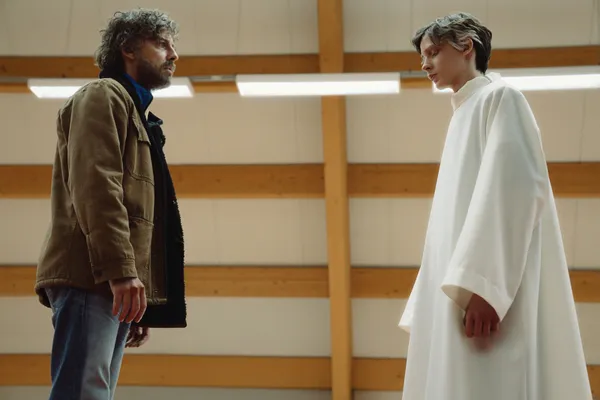

“We prefer to see smiles,” supply PE teacher Sergio Rosetti (a careworn and crumpled Michele Riondino) is told near the start of Paolo Strippoli's enjoyably chilly coming-of-age horror, which played out-of-competition in Venice. Sergio has not long arrived in the town of Remis, but he’s packed the baggage of grief along with his clothes and a parakeet named Oslo. The ex-judo champ is functional enough in school, where he refuses to take no for an answer from reserved 15-year-old Matteo (Giulio Feltri, making a big impression in a debut role that is unlikely to be his last), insisting he joins in with the rest of the kids.
Matteo looks distinctive, with a white Mallen streak in his hair, but after getting drunk in a bar Sergio finds out the teenager’s oddness – which puts him a fine heritage along with Carrie and Thelma – isn’t just skin deep. The barmaid Michaela (Romana Maggiora Vergano) spots Sergio’s sadness and decides to reveal the town’s secret that, during church-like ceremonies, locals line-up to hug Matteo who, miraculously, is able to free them from their pain.

It’s a mammoth undertaking given that the town was ground zero for a terrible train crash years before but Matteo’s father (Paolo Pierobon) is determined that his son fulfils his duties, possibly as partial punishment for what we see happen to his mother in a flashback at the start of the story, who has never fully recovered.
Ambivalence is the name of the game for Strippoli and his co-writers Jacopo Del Giudice and Milo Tissone. While many of the townsfolk view Matteo as an angel, even he himself is not so sure especially as the mounting pressures – including his burgeoning attraction for class bully Lorenzo (Diego Nardini) – lead him to exploring powers that may not be quite so benevolent. The idea of religion as an opiate for the masses is held up to the light but this is a film that is more concerned with scrutinising people’s desire for a quick fix over working through their pain than it is in criticising the church. It’s also likely to strike a chord with many teenagers looking to break out of the box their parents have constructed for them or those who dislike the invasion of their personal space.
Sergio’s sympathy for Matteo, which is not just to coax him to stand up for himself but born out of his own loss, could well transport them from the Valley Of Smiles – the film’s Italian title – to the volcano of unintended consequences. The camerawork from Cristiano Di Nicola has a cool air, with the frequent use of wide angle, smudgy at the edges, adding to the sense of oppression.
There’s ambition on display from the director, who gradually shifts through the gears from moody melancholy through unsettling to a full-on finale that unexpectedly draws on some other horror staples. If it ends up being a little too elaborate for its own good, it’s likely to put a smile on the faces of horror fans who favour the dissection of ideas over dismemberment.
Reviewed on: 01 Sep 2025


Director: Paolo Strippoli
Writer: Jacopo Del Giudice, Paolo Strippoli, Milo Tissone
Starring: Michele Riondino, Romana Maggiora Vergano, Giulio Feltri, Roberto Citran, Paolo Pierobon
Year: 2025
Runtime: 122 minutes
Country: Italy, Slovenia
Festivals:
Fantastic 2025Venice 2025
London 2025
Leeds 2025
Thessaloniki 2025
Overlook 2026
Karlovy 2026
Search database:
